URHOUSE Maupas
The ultimate affordable local retreat

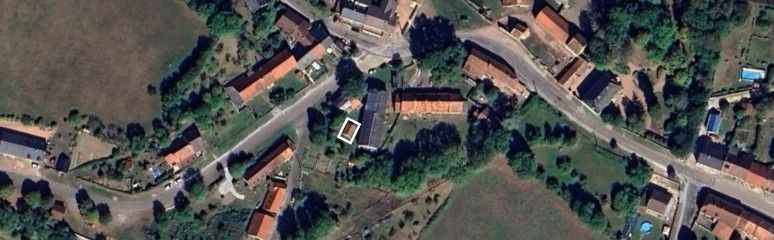
The location
In the countryside of France, time has stood still a bit. Here we find many of the conditions from the 'old days':
- Fewer building regulations. Because we are building on the foundation of an old house, we can follow a simple renovation permit process.
- A location on a large estate. The building is on our own plot, surrounded by our other buildings. All neighbors are well informed and support the project.
- Abundant natural materials. Douglas fir construction wood, small local straw bales (47×37×60 cm), and clay for plastering up for grabs!
- Many friends with skills. We are fortunate to have hardworking friends with machines, tools, and lots of expertise.
- Great times. We keep it fun with good food, Burgundian wine, and great company.
A perfect place to test how we can significantly simplify the construction process — even in our complex modern times!
The parametric design
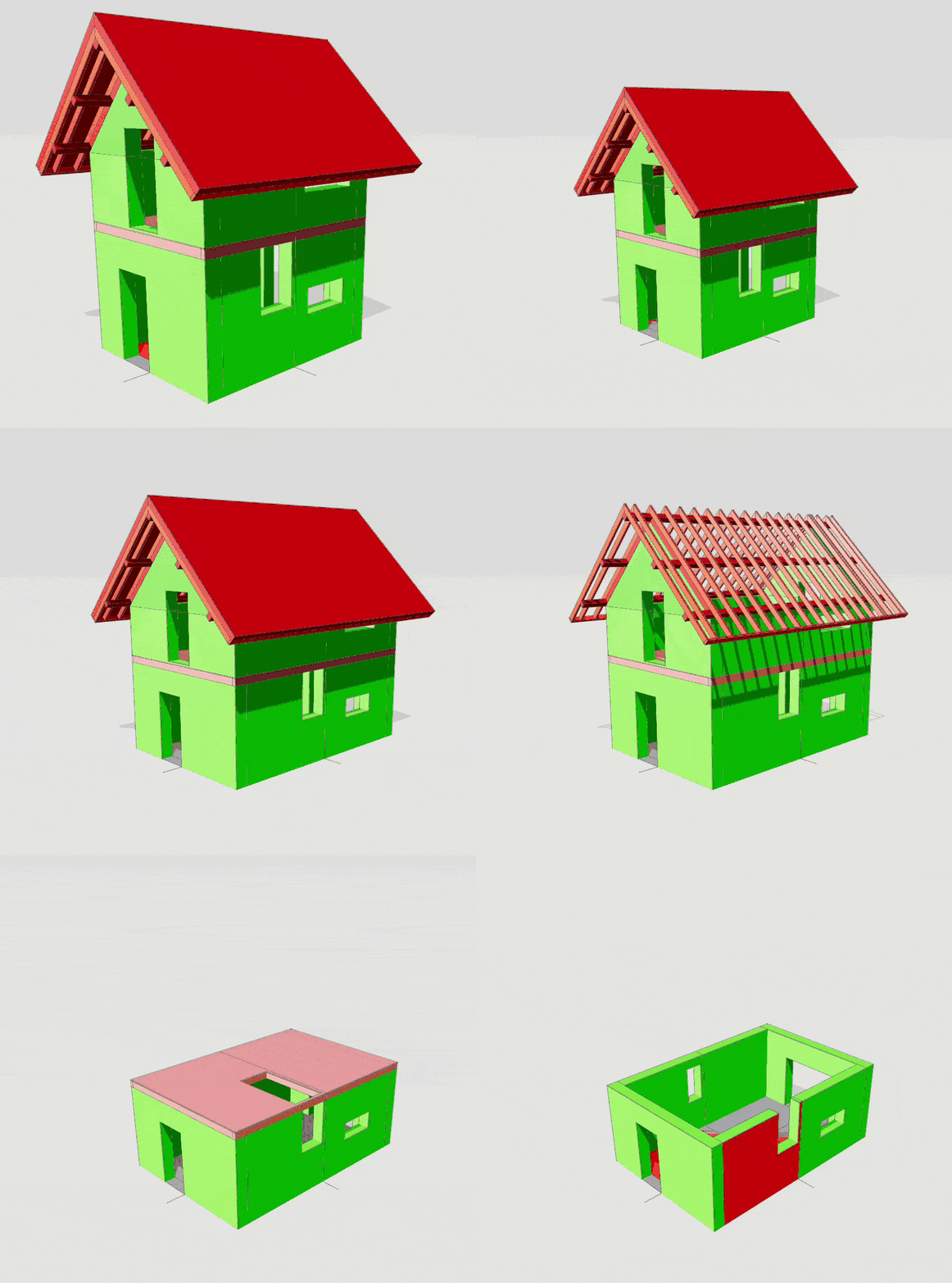 This project serves as a test ground for many of the unique processes developed for URBUILD. We started by adapting our parametric model to the original walls of the existing building. Our version of URHOUSE is deliberately simplified, with a roof angle of 45 degrees and significant overhangs. To achieve that characteristic 'UR feeling', we included rectangular (150x150mm) beams for the rafters and ridge beam. The trusses, also 150 mm high, seamlessly integrate with the overall design.
For the openings, we also chose a practical approach: We place our recycled windows in different places aimed at the surrounding views and depending on the function in the floor plan. In the sitting area, they are low and horizontally placed, overlooking the garden, while in the kitchen they are positioned vertically. On the first floor, two symmetrically placed glass doors form French balconies. This symmetry results in identical facades, which significantly simplifies manufacturing.
The design, with its prominent roof, reflects that of many primal houses - a choice likely stemming from inherent functionality. The generous space under the overhangs effectively extends the interior, ideal for storage or outdoor sitting. It also significantly reduces the weather influences on the facade and openings, enabling simpler details.
The materials
From the parametric model, we directly generate the order list for the local sawmill. It is crucial to order well in advance, as they produce everything to measure, which can take up to a month. Besides the wood for the main construction, we have made an effort to source all other materials locally, preferably directly from the natural source rather than through commercial companies.
Straw is easily available in this region and is mainly used in the stables. As a byproduct of grain production, it costs only about 2-3 EUR per bale. It is important to know the exact bale size before building begins, as it needs to fit precisely between the studs.
The parametric design proved invaluable here; there is no need to constantly create construction drawings, as the computer does this for you. A friend gave us some recycled triple-glazed windows, another fantastic deal that saved us thousands of euros.
The System
Let's be honest: people have been building for centuries. And of course, there's a tendency to complicate things when you're looking for the 'perfect' solution for a specific location, requirements, or style. For URHOUSE, we prioritize proven solutions based on the collective experience and consensus of builders.
Straw construction involves many different systems, with each country often having its own specific, almost cultural approach. Germans, for instance, usually use wooden beams with a section that corresponds to the full depth of a straw bale (around 30 to 40 cm). This method is very sturdy and simple, but the beams are heavy to lift and expensive.
France also has a strong tradition in straw construction, and their organization, Réseau Français de la Construction Paille (RFCP), offers multiple systems. Since we were building in France, we chose one of these: a double wooden frame construction. It later turned out that this method is slowly becoming a consensus across Europe (perhaps with the exception of the Germans!).
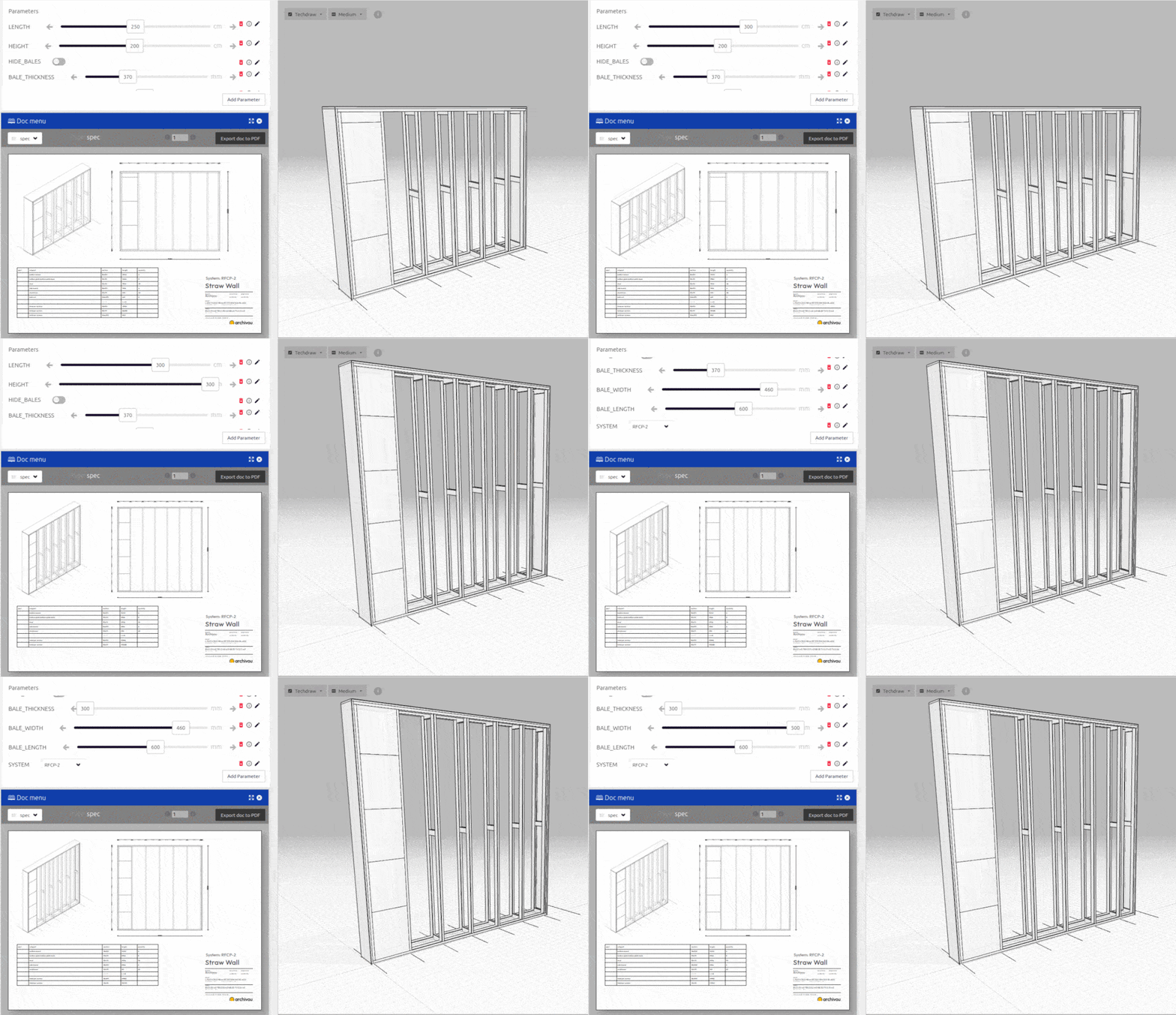
This system consists of two wooden frames connected at the short sides with OSB boards and blocks per stud. It is very lightweight, making it easy to assemble — even by one person — and uses significantly less wood. Although it is somewhat labor-intensive, keeping the design simple and rational means that all frames are identical and can be quickly produced on the ground and stacked together. The first frame then serves as a template for the rest. We also incorporated some detail tricks from classic American wood construction, optimized for fast production and onsite assembly using only one beam section: the famous 2x4" or 2x6".
Because the straw bales need to fit precisely between the studs, it is crucial to know this distance. Straw bales are generally placed vertically (with their longest side up), and the smallest side forms the depth of the wall (37 cm in our case). The other dimension then fills the distance between the studs (46 cm in our case). For a snug fit, make the distance between studs about 0.5 to 1 cm smaller than the actual size of the bale. Modern farmers don't store as many small bales, but you can measure the channel of the straw bale press to know the final bale sizes!
The other parts of the main construction are simple and straightforward. For the roof, we used rafters and trusses to create overhangs on all sides. The two ridge beams are supported by the front and back walls, along with a central roof truss that is a modern interpretation of that in local farms.
The Construction
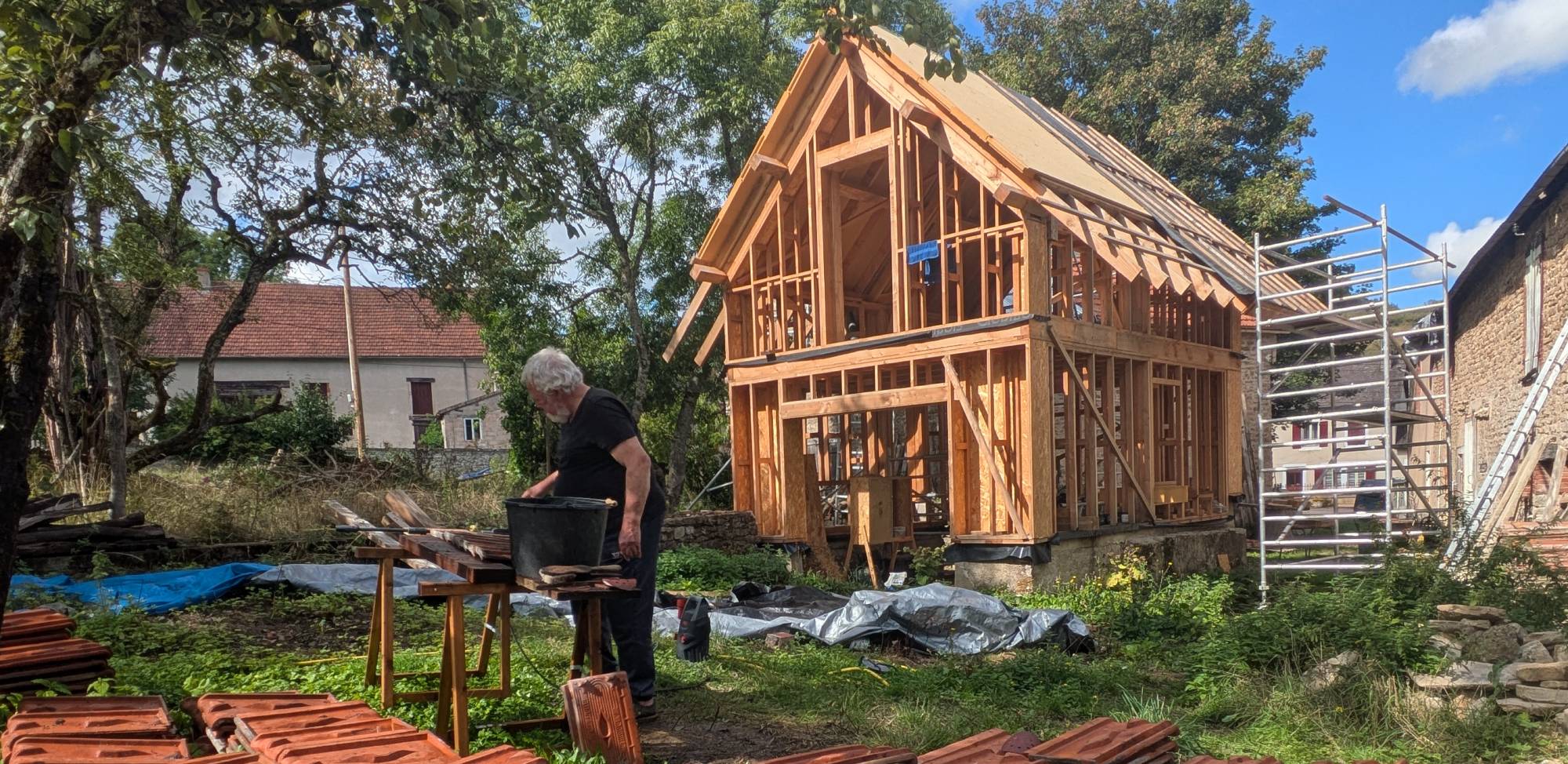
The main construction (demolishing the old building, repairing walls, wood construction, roof, and roof finishing) took about 100 days with an average of one to two people and sometimes several friends at once.
After this period, we completed the roof, giving us some flexibility to continue with the other steps depending on the weather. The straw bales have been stored on the first floor where they can further dry. We have also conducted some tests with clay plaster using our locally sourced clay and straw bales. No need to go to the store!
Below is a video documenting the entire construction process.
This video documents the whole process so far. We started by demolishing a small existing building. The new structure is then directly erected on the old walls, eliminating the need for a new foundation. This approach also significantly reduces paperwork, as we can present it as a renovation instead of a completely new project, in accordance with the French low oversight regulations for the countryside.
The main structure can be built by one person by creating countless identical frames and assembling them. Due to the thickness of the straw bales (37 cm), each wall consists of two frames secured together with blocks and OSB boards.
To be continued
We're at a standstill for the winter as placing the straw bales and clay plastering won't go well then. Construction is expected to resume in the second quarter.