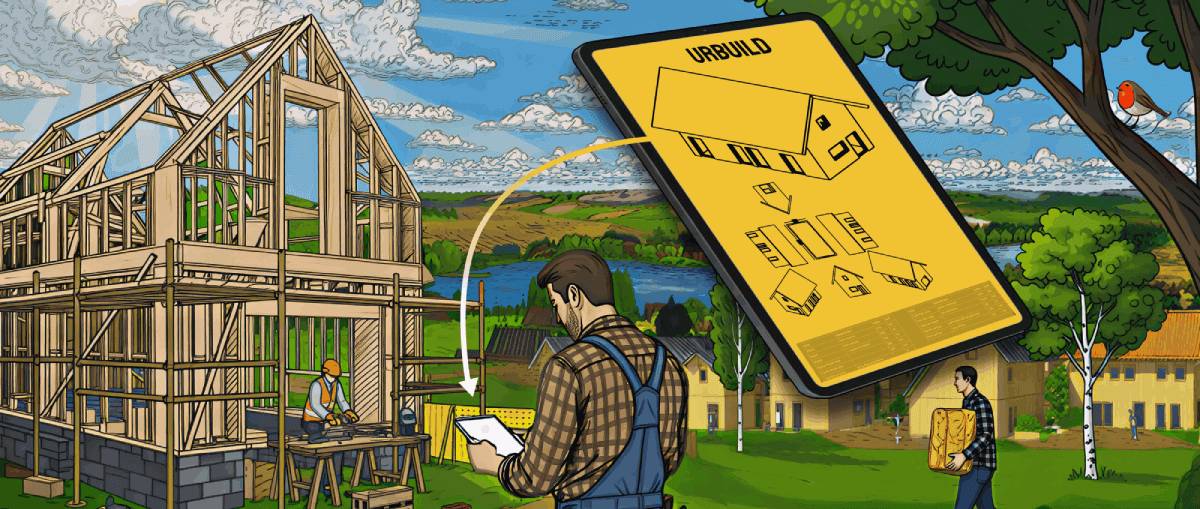
URBUILD: SIMPLIFIED (DIY)BUILDING AND LIVING
How do we make housing affordable and ecological at the same time?
Housing is a basic right, but in our wealthy society it has been too complex, too expensive, and too slow for years. Can't it be simpler? That is URBUILD: the solution to make ecological, unique, and affordable living feasible. How does it work?
From economic restrictions to ecological opportunities
Houses are scarce. Many people complain about it. But a majority - namely the homeowners - benefit from it. That is probably why there is more talk than action.
URBUILD does not wait for policy. We restore the natural and traditional logic in construction and work as much as possible outside the economic system.
Back to a future
In the past, building had little to do with the complexity of the financial system or taxes: it often fell largely outside the formal economy.
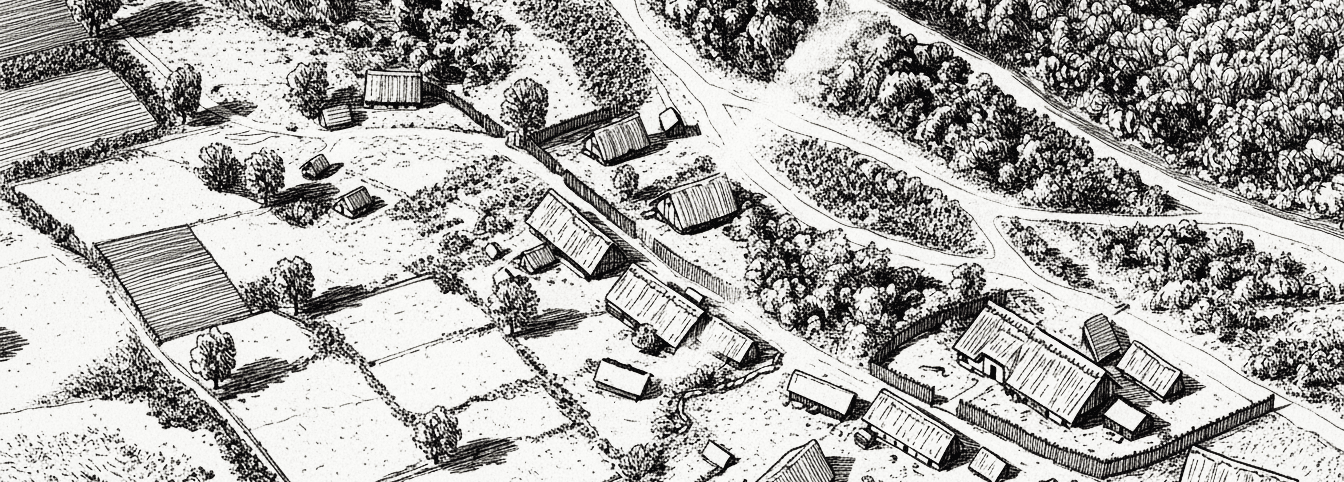
Why have materials come from afar when the cheapest are available locally? Or why pay professionals when you can mostly do it yourself?
Building traditionally in this way is not nostalgic, it is smart. It means: local, cheap materials, generally available knowledge, and a home that fits the lifestyle of the resident.
Ecological = economical = logical!
—
Compare that to now: industrial building products that travel thousands of kilometers, with high energy consumption and greenhouse gas emissions, and every expert and builder with their own concepts and methods. To keep it efficient, houses are built in series and residents have little freedom of choice. And it doesn't even get cheaper!
We can build. But we optimize wrongly: for maximum financial return, uniform industrial production, or a unique architectural solution.
Average clients have wanted the same for millennia: a feasible custom-built home through an effective and open process. And that is what we focus on with URBUILD.
For millennia, people have wanted the same: a feasible custom-built home through an effective and open process.
—
From product to co-building process
Even if a company invents a method to magically create houses at no cost, that does not mean they become free or very cheap. That is simply not how our economy works.
But a resident would know. They prefer to build with materials from the immediate area - natural or recycled - and keep it simple to build themselves or with friends.
URBUILD does not see a home as a product - as a business - but as a joint process. We call this co-building: it saves significant money and often makes the difference between having a home or not.
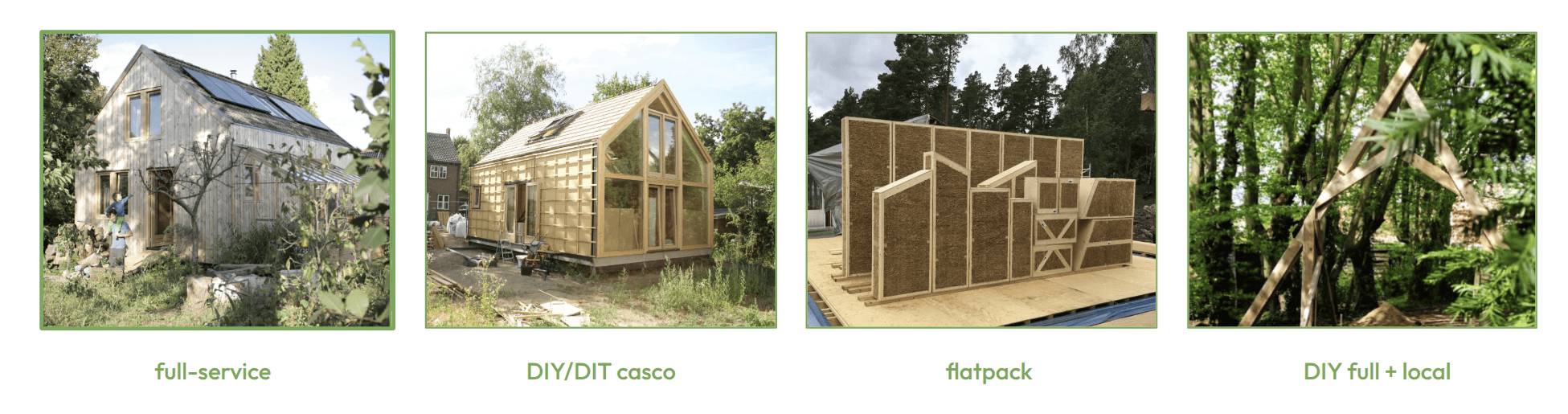
URBUILD does not see a home as a product but as a joint process.
—
Expertise over experts
In the past, construction knowledge was shared and public knowledge (guilds, treaties, pattern books). Typologies bundled knowledge and rules of thumb allowed customization.
Today, the situation is reversed: experts keep their knowledge to themselves and protect it with copyrights and patents. Every builder re-invents the wheel. This makes it unnecessarily complex and expensive.
Seeing knowledge as a privilege slows down scaling, increases costs, and discourages DIYers and professionals from building larger and more ecologically.
The experts at URBUILD believe that expertise should be shared as open source; for this, we use a special automation and publishing platform.
We believe that expertise should be shared as open source; for this, we use a special automation and publishing platform.
Our first open-source eco-home will be online this summer. This way, we demonstrate the advantages: no barriers in construction and new, scalable revenue models for professionals.
From designed uniform homes - to uniquely generated
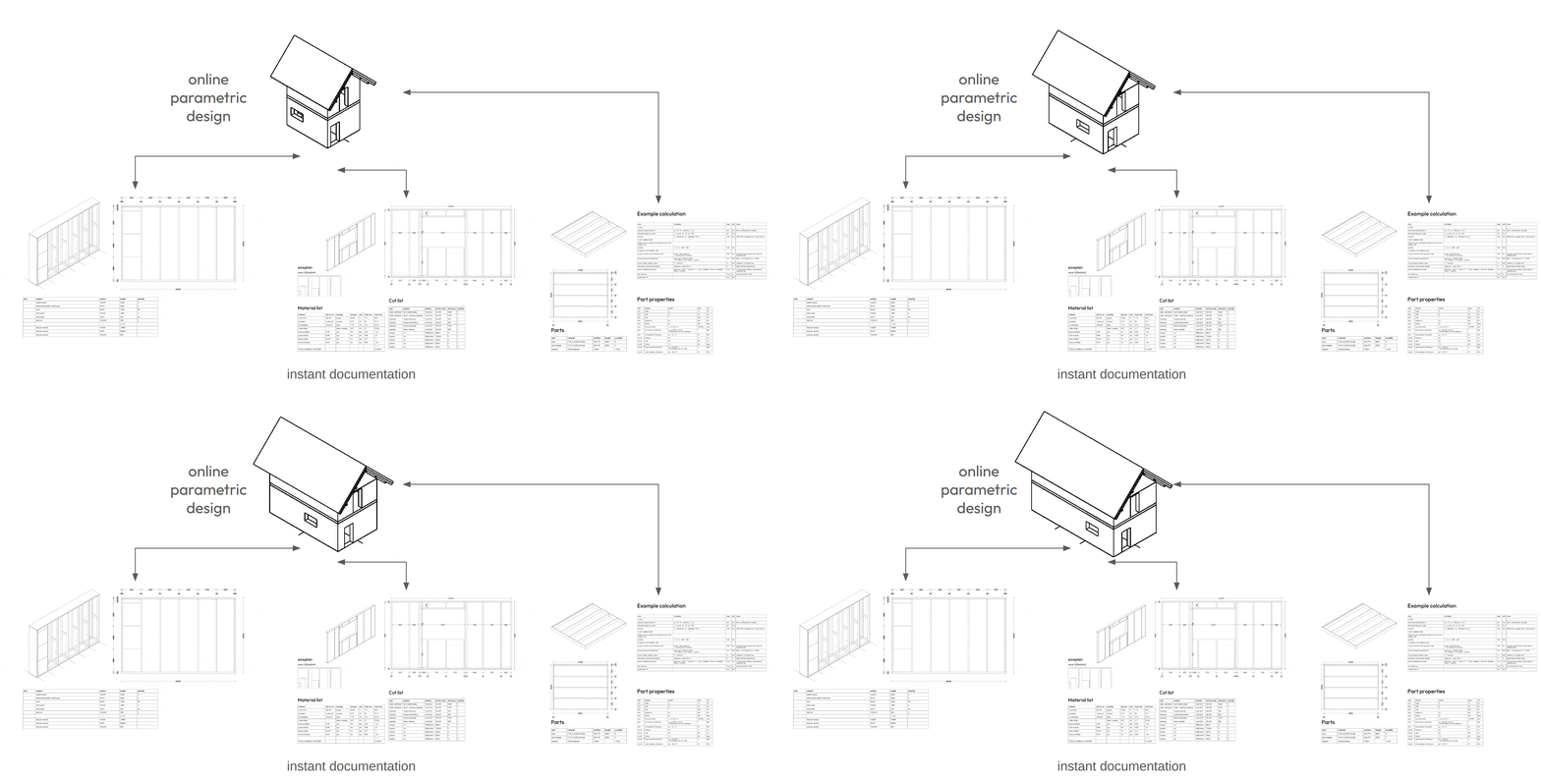 From semi-detached houses to urban areas: construction has too many unique starting points, rules, improvisation, and mistakes. And after land costs and taxes, there is hardly any money left for the construction itself. That must change.
URBUILD automates the process as much as possible. Only the unique design and construction remain human work. Knowledge (drawings, calculations, documentation) is parameterized and generated by computers for each unique project.
 The expert sets up flexible solutions and checks the output. This way, their expertise scales to numerous projects, creating new, efficient business models.
The result: a consistent, efficient, and less risky development process. It gives clients the chance to choose the best solution immediately, as design, budget, energy, and ecological footprint come together at once.
Restrictions become parameters in the process instead of obstacles. And clients experience transparency, flexibility, and interaction.
New traditions
Traditional architecture has emerged from a constant optimization of feasible construction with limited local resources, materials, energy, labor, and shared knowledge.
If we take the reduction of greenhouse gas emissions and affordability seriously, we must learn from those traditions and also forge new paths.
That is the ultimate URBUILD criterion: simple, open, solid, and jointly building towards a renewing construction tradition.
Living for and by people
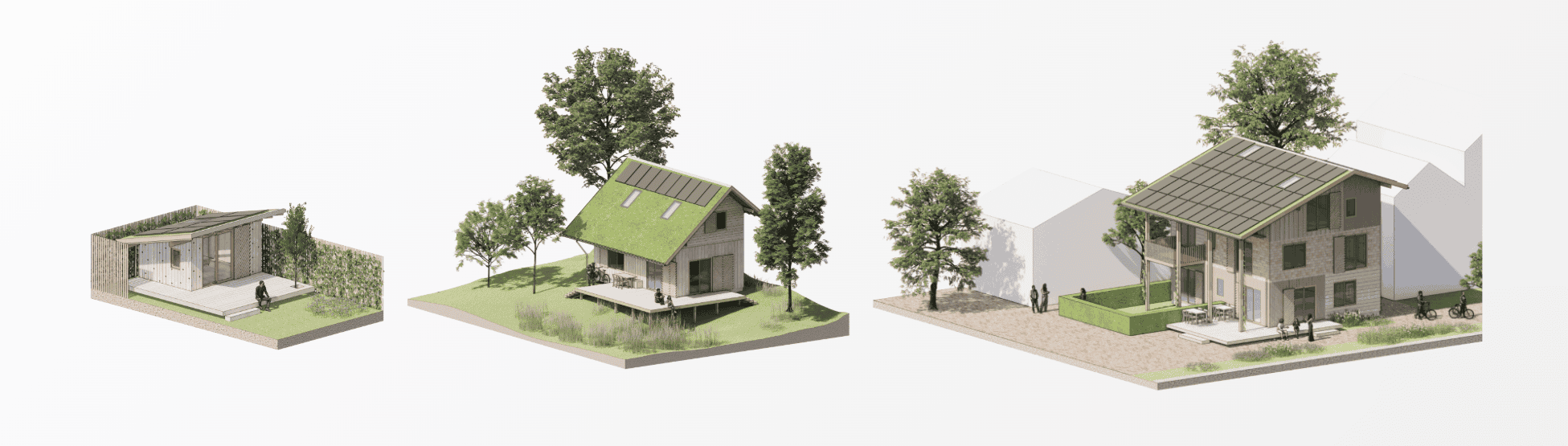
URBUILD makes building simpler, more efficient, more affordable, and higher quality. Our dream: entire neighborhoods with unique, ecological homes where continuous (re)building and living are central.
Some people just go to the bank and pay off, others build incrementally with the money they have, and groups organize themselves to achieve even more together. Here, there is no building for profit; every euro goes to beautiful, unique homes.
No concrete tent camps or stacked barracks, but lush, growing, and thriving neighborhoods: simply for and by people.